AI Demo Automation: The Complete Guide for Sales Teams
Everything you need to know about AI-powered demo automation — what it is, how it works, and why sales teams are using it to scale product demos without scaling headcount.
What would happen if every visitor to your website could see a live, personalized product demo the moment they arrived — no scheduling, no sales rep, no waiting?
That is the question behind AI demo automation. And the answer is reshaping how B2B sales teams operate.
What is AI demo automation?
AI demo automation uses artificial intelligence to deliver interactive, personalized product demonstrations without a live sales rep. Instead of a human walking through slides or a screen share, an AI demo agent navigates your actual product, responds to prospect questions, and tailors the experience based on who is watching.
This is not a recorded video or a clickthrough prototype. It is a live, intelligent walkthrough of your real product. If you are coming from the world of interactive demo tools like Navattic or Storylane, the difference is stark: those tools capture screenshots. AI demo automation controls a live browser.
How AI demo agents work
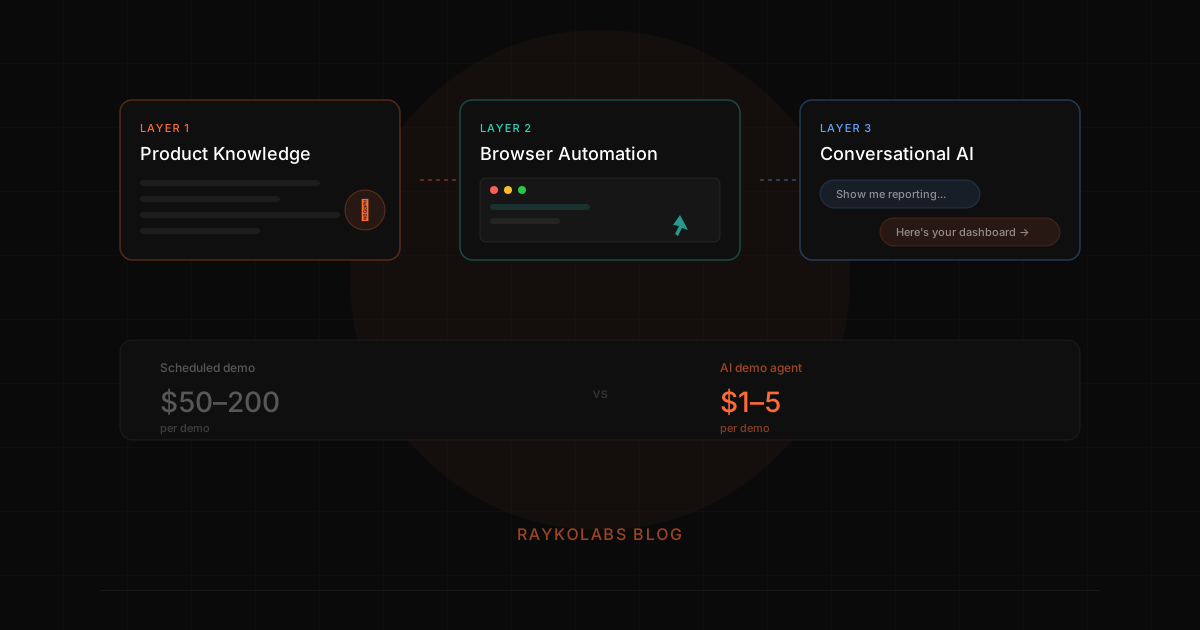
A modern AI demo agent operates in three layers. At RaykoLabs, we call this our three-layer navigation system — and getting the architecture right took us longer than we expected. For a deeper dive, see how the RaykoLabs AI demo agent works.
Layer 1: Context detection and product knowledge
The agent is trained on your product — documentation, FAQs, feature descriptions, use cases, and competitive positioning. But more than memorizing facts, the agent scans the current page state to understand where it is in your application. This context detection layer is what separates a demo agent from a chatbot bolted onto screen recordings.
Layer 2: Navigation planning and browser automation
The agent controls an actual browser session running your product via Playwright and runs those sessions in cloud-hosted browsers through Browserbase. It clicks, navigates, fills in data, and shows real workflows. The navigation planning layer determines the optimal path to whatever the prospect wants to see — and recovers when it hits an unexpected state.
Layer 3: Conversational intelligence
The agent listens via Deepgram for speech-to-text and responds using Cartesia for text-to-speech. It understands what the prospect wants to see and adapts the demo accordingly. If someone asks "How does reporting work?", the agent navigates to reporting and walks through it. Sessions are recorded with rrweb so your sales team can replay exactly what happened.
Why sales teams are adopting this
Scale without headcount
A single AI demo agent can run unlimited concurrent demos. No scheduling, no calendar conflicts, no timezone issues. Whether you get 10 demo requests a day or 1,000, every prospect gets an immediate experience. This matters most when your demo no-show rate is eating half your pipeline.
24/7 availability
Your website traffic does not stop at 5 PM. Neither should your demos. AI agents work around the clock — weekends, holidays, and 3 AM included. Voice-first buyer experiences capture demand that traditional sales orgs miss entirely.
Consistent quality
Every demo follows your best playbook. No off days, no forgotten features, no reps who skip the competitive differentiators.
Richer lead intelligence
Every AI demo session generates data: what features the prospect explored, what questions they asked, how long they spent on each section, and where they dropped off. This gives your sales team qualified, contextual information before they ever pick up the phone.
Faster pipeline velocity
When prospects can see your product immediately instead of waiting three days for a scheduled call, the sales cycle compresses. Interest does not have time to cool. Competitors do not have time to intercept.
Here is what most guides on this topic won't tell you: the AI demo does not need to be perfect to outperform a scheduled call. A demo that is 80% as polished as your best rep — but available instantly, 24/7, with zero no-show risk — will generate more pipeline than a perfect demo that only 50% of prospects attend. We see this pattern over and over.
AI demos vs. traditional approaches
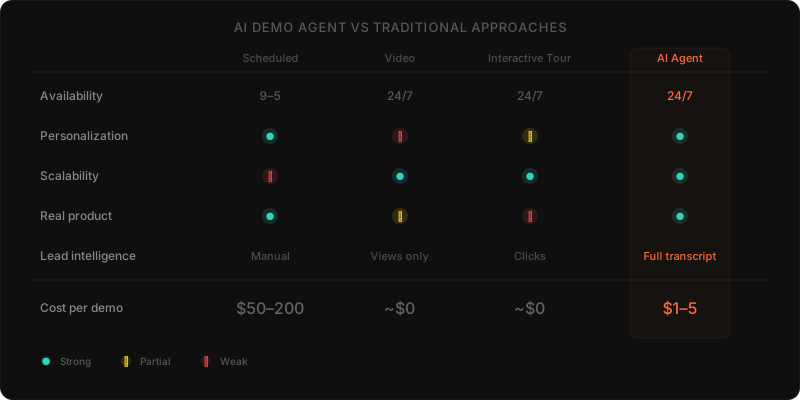
| Dimension | Scheduled demo | Recorded video | Interactive tour | AI demo agent | |-----------|---------------|----------------|-----------------|---------------| | Availability | Business hours | Always | Always | Always | | Personalization | High (human) | None | Low | High (AI) | | Scalability | Limited by reps | Unlimited | Unlimited | Unlimited | | Real product | Yes | Possibly | No (screenshots) | Yes | | Lead data | Manual notes | View count only | Click data | Full transcript + behavior | | Cost per demo | $50–200 | ~$0 | ~$0 | ~$1–5 |
AI demo agents combine the personalization of a live rep with the scalability of self-serve content. For a deeper breakdown of how this stacks up, see our comparison of human vs. AI demos.
What makes a good AI demo experience
Not all AI demo tools are equal. Here is what separates the tools that work from the ones that frustrate prospects.
Real product, not mockups
The agent should navigate your actual application, not a static prototype. Prospects can tell the difference. This is the core limitation of tools like Navattic and Storylane — they show captured screenshots, not living software. See our analysis of browser automation for live AI demos for why this matters technically.
Voice interaction
Text chat is fine for support tickets. For demos, voice changes everything. Prospects talk naturally, ask follow-up questions mid-sentence, and stay engaged longer. The best AI demo agents support real-time voice conversation.
Context awareness
The agent should understand where it is in the product, what it has already shown, and what the prospect seems most interested in. This requires genuine intelligence, not a scripted flow.
Lead capture without friction
Let prospects explore freely. Capture their information naturally through the conversation or offer optional identification. Gating the experience behind a form defeats the purpose.
CRM and workflow integration
Demo data should flow into your existing sales tools automatically — lead scores, transcripts, feature interests, and recommended follow-up actions.
Getting started with AI demo automation
- Identify your top demo flow — start with the product walkthrough that your best reps use most often
- Provide product knowledge — upload docs, FAQs, competitive battlecards, and use case descriptions
- Configure the agent — set the tone, pace, and key talking points
- Deploy on your site — add the demo experience to your website alongside (not replacing) your existing "Book a demo" flow
- Measure and iterate — track completion rates, lead quality, and pipeline impact
- Let your reps review sessions — the AI generates full transcripts and session recordings. Your reps should watch the first 20 sessions to calibrate the agent's messaging.
- Expand to additional flows — once the primary demo is working, add flows for specific personas, verticals, or product modules
Most teams see results within the first week. For the full ROI case, see building the business case for AI demos.
The future of product demos
The demo is not going away. It remains the single most effective way to convert a prospect into a customer. What is changing is who delivers it and when it happens.
AI demo automation makes the product demo an always-available, infinitely scalable experience. For sales teams under pressure to do more with less, that is not just an efficiency gain — it is a competitive advantage. If you want to see the technology behind this shift, read how the RaykoLabs AI demo agent works.
See RaykoLabs in action
Watch an AI agent run a live, personalized product demo — no scheduling, no waiting.
START LIVE DEMORelated articles
AI Demo Agents: What They Are, How They Work, and Why They Matter
The definitive guide to AI demo agents — autonomous AI systems that deliver personalized product demos 24/7. Learn how they work, what to look for, and how they compare to traditional demos.
How Buying Committees Experience AI Demos: A Guide for Enterprise Sales
The average B2B buying group has 6-10 decision makers. Here is how AI demos serve each persona in the committee — and why that changes the enterprise sales cycle.
Digital Sales Rooms + AI Demos: The 2026 GTM Stack
How AI-powered product demos fit into digital sales rooms — and why the combination is becoming the standard GTM architecture for B2B sales teams.